
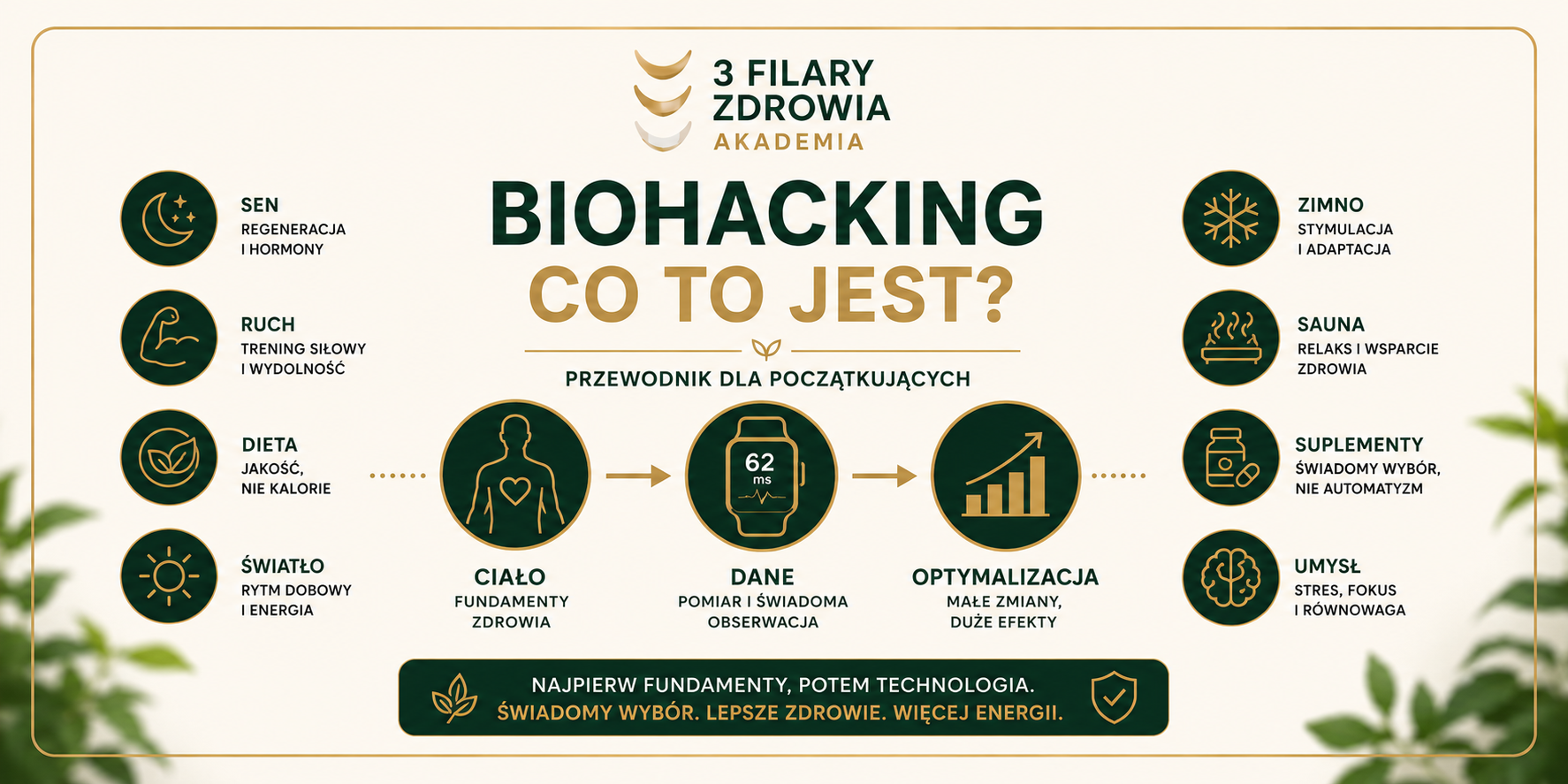
Biohacking — What Is It and How to Start in 2026
You wake up and your head already feels heavy. Coffee helps for an hour, maybe two. Then the fog returns. Evening comes — you are exhausted, but sleep does not arrive. Day after day.
Sound familiar?
If so — you are not alone. And no, this is not "normal." It is a signal that your body and mind need something beyond autopilot. Something science has understood for years, but that is only now reaching a broader audience.
This guide is your map. No hype, no empty promises. Only what works — backed by research, tested by thousands, and accessible to everyone. Including you.
---
What Is Biohacking? A Science-Based Definition
Biohacking is the deliberate, systematic modification of lifestyle, diet, environment, and supplementation to optimize health, performance, and well-being — guided by data and scientific evidence.
The term combines "bio" (biology) and "hacking" (creative problem-solving). It first appeared in an academic context in Yetisen's 2018 paper published in Trends in Biotechnology (DOI: 10.1016/j.tibtech.2018.02.011).
But here is the key distinction — "hacking" does not mean shortcuts. It means conscious experimentation. Listening to your body. Measuring outcomes. Drawing conclusions.
The truth is, most of us live on autopilot. We eat what is convenient. Sleep when we can. Accept stress as inevitable. Biohacking is a decision to take back control — one step at a time, one method at a time.
A Brief History of Biohacking — From Garage Experiments to Mainstream
| Period | Milestone |
|---|---|
| 2004 | Rob Carlson coins "biohacking" (DIY biology movement) |
| 2010 | Quantified Self movement — Gary Wolf and Kevin Kelly promote self-measurement |
| 2011 | Dave Asprey and the Bulletproof Diet bring biohacking to the mainstream |
| 2015-2018 | Wim Hof Method — breathwork and cold exposure go global |
| 2021-2023 | Andrew Huberman — science-based protocols in podcast format |
| 2024-2025 | Bryan Johnson "Blueprint" — extreme longevity protocols |
| 2025-2026 | Democratization: biohacking for women, people 35+, holistic approaches |
Biohacking vs. Medicine — Where Is the Line?
Let us be clear: biohacking does not replace your doctor. It is not an alternative to diagnosis or treatment.
Biohacking is a complement. It is what you do between doctor visits. It is the conscious daily choices that support your health — rather than undermining it.
If you have chronic conditions, take medications, or are pregnant — consult your physician before starting any new practice. This is not a disclaimer formality. It is the foundation of a responsible approach.
---
10 Most Effective Biohacking Practices (Ranked by Evidence)
Below you will find 10 practices ranked by the strength of their scientific evidence — from the most robust to the most preliminary. Each includes specific studies, dosages, and protocols.
| # | Practice | Evidence Level | Cost | Wellness Pillar |
|---|---|---|---|---|
| 1 | Sleep optimization | Strong | Free | Mind + Body |
| 2 | Conscious breathwork | Moderate | Free | Mind + Soul |
| 3 | Intermittent fasting | Strong | Free | Body |
| 4 | Cold exposure | Moderate | Free | Body + Soul |
| 5 | Natural nootropics | Mixed | Medium | Mind |
| 6 | Red light / NIR therapy | Preliminary | High | Body + Soul |
| 7 | Adaptogens | Moderate-strong | Medium | Mind |
| 8 | Personalized supplementation | Promising | Medium | All |
| 9 | Grounding (earthing) | Weak | Free | Soul |
| 10 | Hydrogen therapy | Preliminary | High | Body |
1. Sleep Optimization — The Foundation of Every Protocol
If biohacking had only one rule, it would be this: fix your sleep first.
No supplement, no protocol, no technique will compensate for five hours of sleep in a room lit by screens. Sleep is not a luxury — it is the biological foundation of regeneration, memory, immunity, and hormonal regulation.
What science says:
- A meta-analysis by Abbasi et al. (2022) demonstrated that magnesium supplementation significantly improves sleep quality as measured by the PSQI questionnaire (DOI: 10.1186/s12906-022-03549-2).
- A meta-analysis of 19 randomized controlled trials (Ferracioli-Oda et al., 2013) confirmed that melatonin reduces sleep onset latency by an average of 7 minutes (DOI: 10.1371/journal.pone.0063773).
- L-theanine at 200 mg improved sleep quality without causing daytime drowsiness in a study by Hidese et al. (2019), n=30 (DOI: 10.3390/nu11102362).
- Ashwagandha (300 mg twice daily) improved sleep quality scores in people with insomnia in a randomized trial by Langade et al. (2020), n=80 (DOI: 10.7759/cureus.11025).
- Evening blue light exposure delays melatonin onset by approximately 90 minutes (West et al., 2011; DOI: 10.1210/jc.2011-1100).
- Consistent schedule — same wake time daily, max deviation of 30 minutes, including weekends
- Bedroom temperature — 18-19 degrees C (64-66 degrees F)
- Screen-free 60-90 minutes before bed (or use blue-light-blocking glasses)
- Morning light — 10-15 minutes of exposure to daylight (>10,000 lux) within 30 minutes of waking
- Optional supplements: magnesium glycinate 200-400 mg in the evening, L-theanine 100-200 mg, melatonin 0.5-1 mg (short-term only)
2. Conscious Breathwork — Wim Hof, Box Breathing, Cyclic Sighing
You breathe approximately 20,000 times per day. How many of those breaths are intentional?
Probably none. And that is a missed opportunity — because the way you breathe directly affects your nervous system, stress levels, and even immunity.
What science says:
- In a landmark study, Kox et al. (2014) at Radboud University demonstrated that individuals trained in the Wim Hof method could voluntarily influence their immune response — reducing inflammatory markers after endotoxin administration. This was the first scientific evidence that humans can consciously modulate their immune system (DOI: 10.1073/pnas.1322174111).
- A 2023 Stanford study (Balban et al.) found that 5 minutes of daily cyclic sighing was more effective at reducing stress than 5 minutes of meditation — measured in a randomized trial of 108 participants (DOI: 10.1016/j.xcrm.2023.100895).
- A review of 15 studies on slow breathing (Zaccaro et al., 2018) confirmed that breathing at a rate of 6 breaths per minute improves heart rate variability (HRV) — a key indicator of autonomic nervous system health (DOI: 10.3389/fnhum.2018.00353).
- Box breathing (4-4-4-4): 4 seconds inhale, 4 seconds hold, 4 seconds exhale, 4 seconds hold. Repeat 4-6 cycles. Excellent for acute stress management.
- Cyclic sighing: Double inhale through the nose (short + longer), then slow exhale through the mouth. 5 minutes daily. The simplest and best-studied anti-stress technique.
- Wim Hof: 30 deep breaths, breath hold after exhale (as long as possible), 15-second hold after inhale. 3-4 rounds. Energizing — best as a morning practice.
- 4-7-8 technique: Inhale 4s, hold 7s, exhale 8s. Ideal before sleep.
3. Intermittent Fasting — Science-Based Time-Restricted Eating
Intermittent fasting (IF) is not a diet. It is an eating pattern — you define when you eat, not what you eat.
And contrary to what you might think, this is not a passing trend. It is one of the most thoroughly studied interventions in nutrition science.
What science says:
- A review published in the New England Journal of Medicine (de Cabo & Mattson, 2019) — one of the most respected medical journals in the world — concluded that IF improves insulin sensitivity, lipid profiles, and activates autophagy processes (DOI: 10.1056/NEJMra1905136).
- A randomized trial by Moro et al. (2016) found that a 16:8 schedule led to reductions in body mass and fat tissue without loss of muscle mass in trained men (DOI: 10.1186/s12967-016-1044-0).
A review in Nature Reviews Endocrinology (2022) indicated that aggressive IF protocols (20:4, OMAD) may disrupt menstrual cycles in some women (DOI: 10.1038/s41574-022-00638-x). We recommend a gentler approach for women.
Beginner protocol:
- Weeks 1-2: Start with 12:12 (12 hours eating, 12 hours fasting — e.g., 8 AM to 8 PM)
- Weeks 3-4: Narrow the window to 14:10 (8 AM to 6 PM)
- Advanced: 16:8 (e.g., 12 PM to 8 PM)
- Women: Stay at 14:10 or 16:8 maximum. Avoid longer fasts without professional guidance. If you notice menstrual irregularities — ease the schedule.
4. Cold Exposure — Cold Showers, Dopamine, and Resilience
A cold shower at 7 AM. Sounds like a nightmare? Or perhaps it is one of the simplest ways to feel truly alive within 30 seconds.
What science says:
- A Dutch study by Buijze et al. (2016) involving an impressive 3,018 participants found that daily cold showers (30-90 seconds) reduced sick leave by 29% (DOI: 10.1371/journal.pone.0161749).
- Van Marken Lichtenbelt et al. (2013) showed that cold exposure activates brown adipose tissue (BAT), which burns calories to generate heat (DOI: 10.1172/JCI68993).
- Noradrenaline measurements after cold exposure (Sramek et al., 2000) showed an increase of 200-300% — this neurotransmitter is responsible for alertness, focus, and positive mood (DOI: 10.1007/s004210050065).
- Week 1: At the end of a warm shower — 15-30 seconds of cold water
- Weeks 2-3: Extend to 60 seconds
- Week 4+: 1-2 minutes of cold water (or start with cold)
- Frequency: 3-5 times per week, preferably in the morning
- Temperature: As cold as your tap allows. You do not need an ice bath.
5. Natural Nootropics — Lion's Mane, Bacopa, L-Theanine
Nootropics are substances that support cognitive function: memory, focus, and mental clarity. Natural nootropics — those derived from plants or fungi — have a long history of use and a growing base of scientific evidence.
What science says:
- Lion's mane: A randomized trial by Docherty et al. (2023) showed improved memory in healthy adults after 28 days of supplementation (DOI: 10.3390/nu15224783).
- Bacopa monnieri: A meta-analysis of 9 randomized trials (Kongkeaw et al., 2014) confirmed improvements in attention and information processing speed — though effects require 8-12 weeks of consistent use (DOI: 10.1016/j.jep.2013.11.008).
- L-theanine + caffeine: Camfield et al. (2017) demonstrated a synergistic effect on attention — caffeine stimulates while L-theanine smooths out jitteriness (DOI: 10.1080/1028415X.2017.1320609).
- Lion's mane: 500-3,000 mg daily (extract)
- Bacopa monnieri: 300-600 mg daily, minimum 8 weeks of continuous use
- L-theanine: 100-200 mg (alone or with coffee)
- Ashwagandha KSM-66: 300-600 mg daily
6. Red Light and Near-Infrared (NIR) Therapy
Red light therapy uses wavelengths of 630-670 nm (red) and 810-850 nm (near-infrared). These penetrate cells and support mitochondrial function — the microscopic "power plants" in every cell of your body.
What science says:
- A meta-analysis by Avci et al. (2014) confirmed that red light therapy improves collagen synthesis and accelerates wound healing (DOI: 10.1089/pho.2013.9876).
- Leal-Junior et al. (2019) demonstrated reduction of exercise-induced muscle soreness (DOMS) (DOI: 10.1002/lsm.22950).
Protocol: 10-20 minutes per session, 15-30 cm distance, 3-5 times per week.
7. Adaptogens — Ashwagandha, Rhodiola, Cordyceps
Adaptogens are plants that help your body cope with stress — not by suppressing symptoms, but by normalizing the stress response.
Among them, ashwagandha has the strongest scientific base:
- Salve et al. (2022) demonstrated that ashwagandha (KSM-66, 600 mg/day) reduced cortisol levels by 23% compared to placebo (DOI: 10.3390/jcm11020459).
- The same study reported improvements in sleep quality and perceived stress reduction.
8. Personalized Supplementation — Biomarkers and Bloodwork
This is not "grabbing something off the shelf." It is a data-driven approach: measure first, then supplement.
What science says:
- A meta-analysis of 25 randomized trials (Martineau et al., 2017) found that vitamin D reduces the risk of respiratory infections by 12% overall, and by 36% in those with deficiency (DOI: 10.1136/bmj.i6583).
- Hemila (2017) found in a systematic review that zinc may shorten cold duration by approximately 33% (DOI: 10.1093/ofid/ofx059).
- Get bloodwork — minimum: complete blood count, vitamin D, vitamin B12, iron/ferritin, magnesium, TSH, lipid panel, fasting glucose
- Address deficiencies — do not supplement blindly
- Introduce 1-2 supplements for a specific goal — not an entire stack at once
- Retest every 3-6 months — verify that supplementation is working
9. Grounding (Earthing) — Science vs. Marketing
Grounding involves walking barefoot on earth, grass, or sand — with the goal of "earthing" the body and reducing free radicals through contact with the earth's electrons.
Honestly: Scientific evidence is currently weak. Existing studies (e.g., Chevalier et al., 2012; DOI: 10.1155/2012/291541) have small sample sizes (<20 people) and lack independent replication.
Is walking barefoot on grass pleasant and relaxing? Yes. Is it "therapy"? Science has not confirmed this yet. Treat it as a pleasant ritual, not a health intervention.
10. Hydrogen Therapy — What Do We Know?
Hydrogen water and hydrogen inhalation are relatively new trends. The biological mechanism is plausible — hydrogen may act as a selective antioxidant, neutralizing the most harmful free radicals (hydroxyl radicals), as described by Ohta (2011; DOI: 10.1016/j.pharmthera.2011.05.006).
Honestly: Most data comes from in vitro (test tube) and animal studies. Human studies are few and preliminary. "Promising" does not mean "proven." For now — we observe with curiosity but do not recommend it as a priority investment.
---
Biohacking Supplements — How to Build Your First Stack
A "stack" in biohacking language is a set of supplements chosen for specific goals. But before you start building yours — remember one thing:
More is not better. The dose-response curve is U-shaped — beyond the optimum, side effects increase while benefits decrease.
The Minimal Evidence-Based Stack: D3+K2, Magnesium, Omega-3
If you could take only three supplements — and not a single one more — here is what has the strongest scientific justification:
- Vitamin D3 + K2 — 2,000-4,000 IU daily (after testing your 25(OH)D level). K2 supports proper calcium distribution.
- Magnesium (glycinate or taurinate) — 200-400 mg in the evening. Supports sleep, muscles, and the nervous system. The form matters enormously.
- Omega-3 (EPA/DHA) — 2g total daily. Anti-inflammatory, brain health, cardiovascular support.
How to Read Biohacking Supplement Labels
Not every supplement on the shelf deserves your attention. The difference between a worthwhile product and marketing noise is often hidden in the fine print.
What to look for:
- Form of the ingredient — not just "magnesium," but WHICH magnesium (oxide vs. glycinate is a vast difference in bioavailability)
- Active substance dose — not the capsule weight, but the milligrams of active compound
- Additives — the shorter the "other ingredients" list, the better
- Certifications — GMP, third-party testing, manufacturer transparency
Biohacking for Women vs. Men
Why Sex Matters in Biohacking
Most biohacking research has been conducted on men. This is a fact that must be kept in mind — because the female body responds differently to many interventions.
Key differences:
- Intermittent fasting: Aggressive schedules (20:4, OMAD) may disrupt menstrual cycles, lower LH and FSH. Women should start gently (12:12, then 14:10) and monitor their cycle.
- Cold exposure: Women often have lower cold tolerance — begin with shorter exposures and build gradually.
- Iron supplementation: Women of reproductive age are more likely to have iron deficiency. Bloodwork is essential.
- Adaptogens and the cycle: Some women find ashwagandha works better in the luteal phase than the follicular phase. Observe and adjust.
Protocols by Persona — Where to Begin
For women 35+: Start with sleep + breathwork. Add magnesium in the evening. After 4 weeks, consider D3+K2. Only then — adaptogens or nootropics.
For men 35+: Same foundation — sleep + breathwork. Cold exposure can be introduced sooner. Supplements: D3+K2, magnesium, zinc (if deficient). Nootropics and adaptogens after the fundamentals are stable.
---
What Biohacking Is NOT — 5 Myths Debunked
Myth 1: "Biohacking replaces your doctor"
No. Biohacking is a COMPLEMENT to medicine, not a substitute. If you have symptoms of illness — see your doctor. If you have a diagnosis — follow your doctor's guidance. Biohacking enters where conventional medicine ends with "you are healthy, try not to stress."
Myth 2: "More supplements = better"
Your body is not a bottomless cup. Every nutrient has an optimum — below it, deficiency; above it, side effects. More vitamin D does not mean "better" — it can mean toxic. Measure, do not guess.
Myth 3: "Detox is biohacking"
Your liver and kidneys "detoxify" you 24 hours a day, 7 days a week. They do not need celery juice to do their job. EFSA (European Food Safety Authority) does not permit health claims for "detox" products — because there is no scientific basis to formulate them.
Myth 4: "Biohacking is for tech bros"
In 2026, the typical biohacker is not a Silicon Valley millionaire. It is a woman, 35+, a mother, a professional looking for ways to have more energy, sleep better, and feel good in her own body. Biohacking is democratic — its foundations (sleep, breath, movement, light) are free.
Myth 5: "Results are immediate"
If someone promises results after one day — walk away. Most legitimate biohacking interventions require 4-12 weeks of consistent practice to produce measurable effects. Patience and consistency are a biohacker's superpowers.
---
How to Start Biohacking — Your First Month Plan
Here is your plan — simple, nearly free, and evidence-based. You do not need to do everything at once. One step at a time.
Weeks 1-2: Sleep and Light
Goal: Stabilize your circadian rhythm.
- Set a consistent wake time (even on weekends) — maximum 30-minute deviation
- Go outside within the first 30 minutes of waking — even 10 minutes of daylight exposure makes a difference
- Lower bedroom temperature to 18-19 degrees C (64-66 degrees F)
- Eliminate screens 60-90 minutes before bed (or use blue-light-blocking glasses)
- Optional: magnesium glycinate 200-400 mg, 30-60 minutes before sleep
Weeks 3-4: Breathwork and Cold Exposure
Goal: Regulate the nervous system.
- 5 minutes of breathwork daily — start with cyclic sighing (simplest, best data)
- Cold shower: start with 15-30 seconds at the end of a warm shower
- Gradually extend to 60 seconds
- Morning — not evening (cold is stimulating)
Supplements to Add After 4 Weeks
Only now — when the foundations (sleep + breathwork + cold) are in place — consider supplementation:
- Vitamin D3 + K2 — especially if untested or below 30 ng/ml
- Magnesium — if not yet introduced in week 1
- Omega-3 — 2g EPA/DHA daily
- Optional (goal-specific): ashwagandha for stress, L-theanine for focus, lion's mane for memory
---
FAQ — Frequently Asked Questions About Biohacking
What is biohacking?
Biohacking is the conscious optimization of body and mind using science-based tools: from sleep hygiene and breathwork, through supplementation and cold exposure, to advanced therapies like red light or molecular hydrogen.
Is biohacking safe?
Most foundational practices (sleep, breathwork, morning light) are safe for healthy adults. Supplementation requires medical consultation, particularly if you take medications or have chronic conditions. Advanced practices (cold exposure, intermittent fasting) should be introduced gradually.
Where should I start with biohacking?
Start with sleep optimization — morning light exposure, bedroom temperature of 18-19 degrees C, consistent schedule — and conscious breathwork (5 minutes of cyclic sighing daily). These are free practices with the strongest scientific evidence.
What supplements should I take for biohacking?
The evidence-based minimum is: vitamin D3+K2 (2,000-4,000 IU), magnesium glycinate (200-400 mg in the evening), and omega-3 EPA/DHA (2g daily). After 4 weeks, consider ashwagandha (300-600 mg KSM-66) for stress or L-theanine (100-200 mg) for focus.
Does biohacking work differently for women and men?
Yes. Women should adapt protocols to menstrual cycle phases — for example, shorter fasting windows and iron supplementation during the menstrual phase. Men may focus on testosterone optimization through sleep, strength training, and zinc.
How much does biohacking cost?
The fundamentals — sleep, breathwork, cold exposure, morning light — are free. Basic supplementation (D3+K2, magnesium, omega-3) costs approximately 20-40 EUR per month. Advanced tools (RLT panels, Oura Ring) represent an investment from several hundred to several thousand euros.
---
What Comes Next?
Biohacking is not a sprint. It is a way of life. It is not about "hacking" your body in a weekend — it is about consciously, step by step, building a version of yourself that has more energy, clarity, and calm.
If this article was valuable to you — consider subscribing to our weekly newsletter. Every Friday, we send one protocol, one study, one practical tip. No spam, no hype. Only what truly works.
And if you are ready to take your first step in supplementation — visit our [shop](/shop). We describe every product honestly: what the science says, what you can expect, and what you should not. Because we believe an informed choice is a better strategy than an empty promise.
The choice is yours. But the fact that you have read this far tells me you are looking for something beyond autopilot.
And that is a beautiful beginning.
---
The information in this article is for educational purposes only and does not constitute medical advice. Dietary supplements do not replace a varied diet or a healthy lifestyle. Before starting supplementation, cold exposure, intensive breathwork, or intermittent fasting, consult a physician — especially if you are pregnant, breastfeeding, taking medications, or have chronic conditions. Cold exposure: do not practice with heart disease, Raynaud's syndrome, or during pregnancy. Wim Hof breathing: never in water or while operating a vehicle; contraindicated in epilepsy.
Zespół 3 Filary Zdrowia